
Stimuli-responsive Optical Materials & Devices
Contact Information
Address
- Het Kranenveld 14
- Helix
- 5612 AE Eindhoven
- Netherlands
- View on map, opens in new tab
Postal address
- Postbus 513
- Department of Chemical Engineering and Chemistry
- 5600 MB Eindhoven
- Netherlands
- View on map, opens in new tab
Introduction
To reduce energy consumption in the built environment and transport, we develop smart materials that actively respond to their environment. Research includes smart windows, urban solar energy technologies, light-responsive systems, and adaptive coatings for energy-efficient and sustainable applications.
Profile
‘Smart’ windows
We develop smart windows that reversibly control transmission of visible and/or infrared light to reduce power demands for lighting, heating and cooling of building spaces, create switchable ‘privacy’-state glass, and assist in greenhouse plant growth by manipulating color and distribution of incident sunlight. By using liquid crystals as a basis, selective regions of the solar spectrum can be rejected, transmitted, or absorbed to generate power or heat. Triggers for window switching can be temperature, humidity, light intensity, or human input.
We also develop smart windows that modulate their optical transparency under an external trigger such as electricity, light or heat. Generally, the windows switch between a transparent and an opaque states and light is regulated to be either transmitted or blocked. The light-blocking state can be white, black or colored and the devices can be used for their hiding power, maximizing comfort for privacy purposes (bath rooms, bed care in hospitals) or be part of light management systems controlling light and color distribution in living and working area. This topic is in close collaboration with SCNU-TUE Joint Lab of Device Integrated Responsive Materials (DIRM). New principles developed can be transferred to our pilot-line in China for upscaling.
Urban energy generators
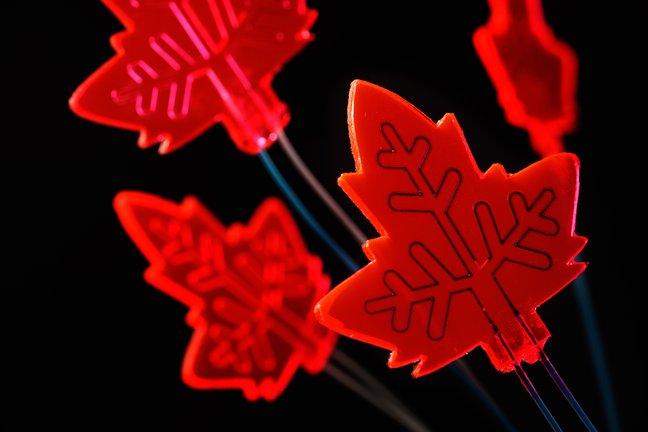
We are a world leader in research on luminescent solar concentrators (LSCs), inexpensive plastic devices capable of being made in almost any color and shape with considerable visual appeal, ideal for use in the crowed city setting for generating electricity from sunlight. We are involved in both fundamental research by developing new colored molecules and ordering them over the device surface for enhanced light control, as well as upscaling the devices with the goal of commercialization in the near future.
Mechanical light-responsive elements
We use liquid crystal actuators to control light entrance into greenhouses by unrolling tiny reflectors that reject infrared light but allow passage of the visible light plants need for growth. Ideally, we deposit the material by inkjet printing to allow large area coverage in a very controlled way. We also research piezoelectric materials that can harvest energy from various motions: we look to deploy these tiny elements to help power micromachines.
Smart Coatings
Polymer coatings play an important role in our society protecting everyday objects from environmental influences. Furthermore, these coatings are also widely used for aesthetic purposes, adhesion-promotion/reduction, self-cleaning and/or anti-fouling. We focusse on smart materials and coatings that switch their optical properties, permeability and/or their shape when exposed to stimuli such as temperature, light and electricity. For example, we work on stimuli responsive coatings that are able to change their topography and surface chemistry. Such coatings are highly interesting for antifouling drag reduction of ships to self-cleaning of solar cells in the desert.