Group Goorden
We focus on synthesis-based engineering for safety and performance of supervisory control software
Contact Information
Postal address
- Postbus 513
- 5600 MB Eindhoven
- Netherlands
- View on map, opens in new tab
Introduction
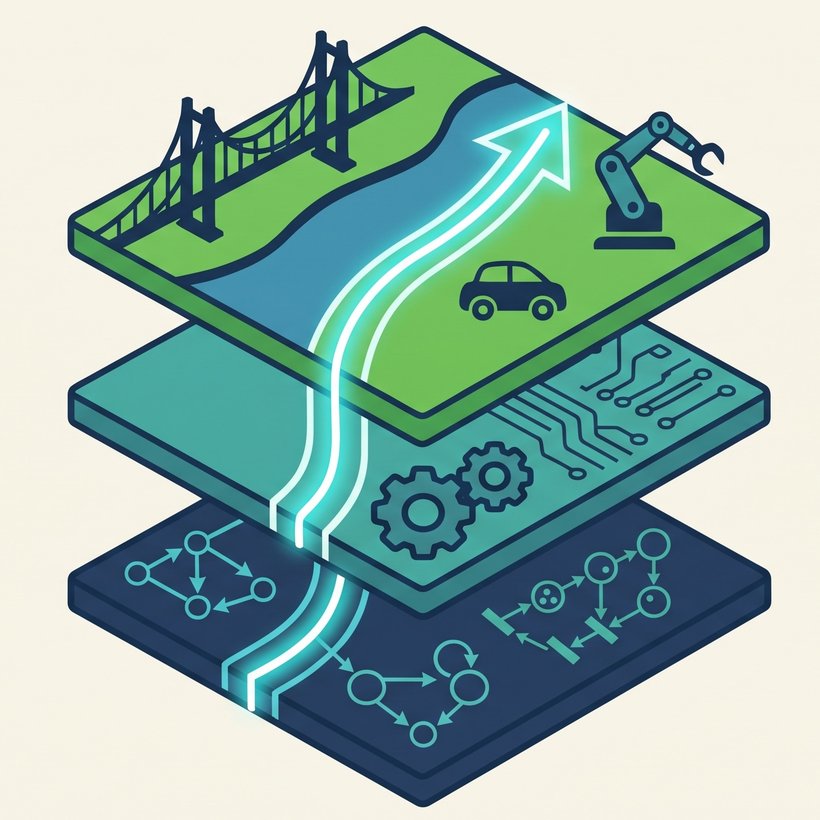
Our group makes synthesis-based engineering work in practice. We develop new methods for controlling complex cyber-physical systems, turn them into software tools that engineers can actually use, and apply them to real industrial installations. Our aim is that critical systems are controlled correctly, and that the organizations running them can rely on the result with confidence.
Profile
The group advances the state of the art and the state of the practice in model-based engineering of supervisory controllers. Our work starts from formal models of the system and its requirements, and uses supervisory controller synthesis to construct control software that is correct by construction.
A first research theme is scalability. We develop compositional and multilevel synthesis techniques that make correct-by-construction synthesis tractable for large-scale systems with many interacting components, including networked and bus-structured discrete-event systems. A second theme combines supervisory control with performance and throughput optimization. Supervisory control synthesis produces a supervisor that includes as much safe behavior as possible, but we also want systems to behave optimally with respect to criteria such as minimal energy cost, maximum throughput or minimal waiting times; we therefore search within the safe behavior for strategies that are both safe and optimal. A third theme broadens the class of properties and models that synthesis can handle, covering timed systems, partial observation, probabilistic frameworks and security-related properties such as opacity, together with the specification theory needed to reason about them compositionally.
Application areas include manufacturing and high-tech systems such as lithography manufacturing, automotive systems, waterway locks, bridges and lock-bridge combinations, storm surge barriers, tunnels and sluices, urban water management, robotics and autonomous systems, and semiconductor manufacturing equipment.
Theory alone is not enough. The group is a lead developer of the Eclipse ESCET toolkit, a contributor to ECDAR, and a key user of UPPAAL. We work closely with industrial and public infrastructure owners, translating our methods into their engineering practice, and we actively seek such collaborations to keep our research grounded in real engineering problems.