
Dynamic systems
Synthetic compartments with adaptive functions
Contact Information
Postal address
- Postbus 513
- Helix Building
- 5600 MB Eindhoven
- Netherlands
- View on map, opens in new tab
Address
- De Groene Loper 3
- Helix Building (STO 3.39)
- 5612 AE Eindhoven
- Netherlands
- View on map, opens in new tab
Phone
- +31 40 247 3737
Email
Introduction
The Dynamic Systems group builds synthetic materials that move, change shape and respond to chemical signals. We design polymer compartments that mimic selected functions of living cells, revealing how molecular interactions create adaptive behaviour and opening routes to artificial cells, nanomedicine and materials with programmable functions.
Profile
Living cells continuously adapt to their surroundings. Can we give synthetic materials some of the same abilities? At Dynamic Systems, we combine polymer chemistry with supramolecular self-assembly to build compartments whose structure and activity respond to their environment. Our research connects the design of individual molecules to the behaviour of particles and communities of artificial cells.
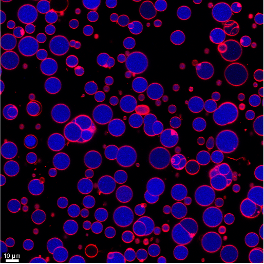
A central platform is the polymersome: a tiny hollow capsule with a polymer membrane. By controlling its composition and shape, we regulate which molecules enter or leave and how reactions proceed inside. Bowl-shaped capsules, called stomatocytes, can house enzymes that drive motion or trigger changes in assembly. We also build artificial cells from lipid vesicles and polymer-rich droplets to study chemical communication and adaptive behaviour.
Our results include artificial-cell populations that exchange chemical signals to reorganise DNA structures, and vesicles containing responsive hydrogels that change their internal viscosity and enzyme activity. We use microscopy and quantitative particle characterisation to understand how these functions arise.
This research contributes to Health through responsive delivery systems and artificial organelles, and to Future Tech through active particles and materials with programmable responses. These are research platforms for exploring future applications. Our longer-term ambition is to create synthetic systems whose past chemical exposure influences their subsequent behaviour.