
Computational Chemical Engineering
From particle-scale physics to reactor design
Contact Information
Address
- Het Kranenveld 14
- Helix
- 5612 AE Eindhoven
- Netherlands
- View on map, opens in new tab
Postal address
- Postbus 513
- Department of Chemical Engineering and Chemistry
- 5600 MB Eindhoven
- Netherlands
- View on map, opens in new tab
Phone
- +31 40 2474931
Email
Introduction
We use computer simulation to look inside chemical reactors. From the flow around single particles and bubbles to models of a complete reactor, we develop methods and open-source software for designing processes that use less energy and raw material, and we test how far these models can be trusted.
Profile
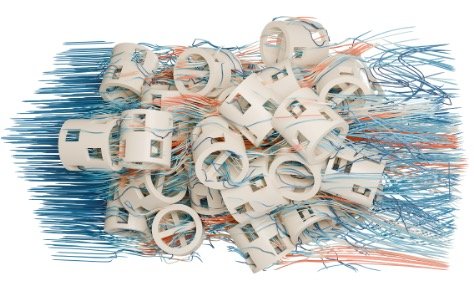
Many chemical reactors combine gases, liquids and solids: catalyst pellets in a packed or trickle bed, a powder kept in motion by gas in a fluidized bed, or bubbles rising through a liquid in a bubble column. What happens around each particle or bubble decides how well the reactor works, but one cannot easily look inside. Therefore, we simulate it, resolving the flow, heat and mass transfer and reaction around every particle and bubble.
Such simulations are computationally demanding. We write our own software, Peclet, for graphics processors (GPUs). It runs from a laptop up to the national supercomputer, where we have simulated flow through a particle bed on almost two billion grid cells. Peclet is open source, like our reactor-modelling package PyMRM, which we also use in teaching.
Detailed simulations remain too slow for designing a plant. We therefore also build phenomenological models, such as pore-network and one-dimensional reactor models, and use the detailed simulations to check where they break down. We contribute such models to joint projects with colleagues and industry on dryers, adsorption columns, electrochemical reactors and ammonia synthesis.
Many processes for the energy transition use particles that react many times. While reacting, the particles become porous, change shape and stick together, until the reactor no longer works. We want to predict when this happens.
We also study how AI agents can help to build and check simulation models. Our aim is reliability: assumptions are made explicit and results are checked independently.