
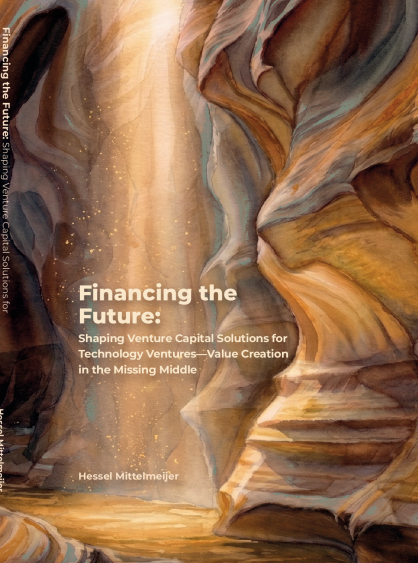
Financing the Future: Shaping Venture Capital Solutions for Technology Ventures—Value Creation in the Missing Middle
Output:
Thesis
Phd Thesis 1 (Research TU/e / Graduation TU/e)
Academic

Open access
Information
Output type
Output:
Thesis
Phd Thesis 1 (Research TU/e / Graduation TU/e)
Academic
Original language
EnglishQualification
Doctor of PhilosophyPublication milestones
- Accepted/In press - 17/11/2026
Publication status
Accepted/In press - 17/11/2026
Supervisors/Advisors
- A.G.L. Romme (Promotor)
- S.A.M. Dolmans (Promotor)
Place of publication
EindhovenAward date
17/11/2026Publisher
Eindhoven University of TechnologyISBN (Print)
978-94-6537-749-0Abstract
Technology ventures play a central role in driving innovation, economic growth, and societal well being, yet most struggle to survive the transition from early-stage technological development to commercial scaling. This survival challenge, known as the missing middle or valley of death, is characterized by high technological uncertainty, significant capital intensity, long development cycles, and a persistent imbalance between the supply and demand of early-stage funding. These challenges are particularly acute in deep tech domains, where ventures often require years of R&D investment before generating revenue. Despite the importance of venture capital in ad-dressing these challenges, scholarly and practical knowledge remain fragmented across the fields of entrepreneurial finance and technology entrepreneurship. This dissertation addresses this gap by investigating how venture capital solutions can help technology ventures overcome the missing middle and create economic, societal, and environmental value. It does so through four interconnected studies that integrate mechanism-based theorizing, design science, and a comparative case study. The study described in Chapter 2 develops a systems-level theoretical foundation. Through a mechanism based review of 201 peer reviewed articles, it identifies eight mechanisms, such as signaling, resource acquisition, knowledge spillovers, and capital structure optimization, and seven agency types that shape venture trajectories. These insights are synthesized into a causal loop diagram capturing the dynamic interplay of mechanisms across two phases: applied R&D and commercialization. The resulting framework reframes the missing middle not as a linear funding gap but as a dynamic tipping point governed by shifting feedback loops, illustrating how ventures can become trapped in vicious cycles or propelled into sustainable growth. The second study (in Chapter 3) translates these theoretical insights into a real-world venture capital fund (VC) for seed stage deep tech ventures. Using design science methodology, it develops and implements DeepTechXL, a €118 million Dutch VC fund designed to address the structural shortcomings of early stage deep tech financing. Chapter 3 identifies critical design requirements, including minimum viable fund size, staged financing strategies, multi disciplinary teams, and syndication logic, and codifies them into two design propositions. These propositions highlight the importance of an impact oriented investment thesis, ecosystem signaling, and an extended fund life to accommodate deep tech development cycles. DeepTechXL’s successful fundraising and early deployment validate the fund’s design and demonstrate how design science can be used to develop actionable venture capital solutions. The third study (in Chapter 4) focuses on the growing requirement for VCs to integrate sustainability into investment decisions, driven by regulatory frameworks such as the EU Sustainable Finance Disclosure Regulation (SFDR). Despite these pressures, VCs lack tools for assessing sustainability impact under conditions of uncertainty and limited data. Chapter 4 develops the VC Green Scheme, a sustainability assessment framework tailored to early stage technology ventures. Drawing on an extensive literature review and empirical insights from thirteen European VC funds, it synthesizes eight final design principles and operationalizes them into a five step process integrated throughout the VC investment cycle. Implemented and evaluated at DeepTechXL, the framework demonstrates high usability, compliance, and practical relevance, providing a structured approach to assessing and reporting sustainability impact.The fourth study (in Chapter 5) examines how VCs create value beyond capital. Although VC involvement is widely considered essential, existing research largely reduces value adding activities to descriptive lists and overlooks the technological dimension of value creation. Through a comparative case study of twelve European VC funds combined with a structured literature re-view, Chapter 5 develops the VC value creation framework, a multidimensional model organizing VC involvement across three domains, namely strategic, operational, and technological, and two modes of engagement, labelled direct and indirect. The framework highlights the central role of technological support in reducing technical uncertainty, structuring R&D trajectories, and validating technological progress, especially in deep tech contexts. It also identifies venture side and VC side contingencies that shape the effectiveness of VC involvement and shows how value adding activities contribute to value inflection points relevant for follow on financing and long term outcomes. Together, these four studies produce an integrated conceptual understanding of the venture <br/>capital–technology venture dyad. Chapter 6 synthesizes the findings into an overarching framework that clarifies how VCs and technology ventures jointly shape progress through iterative cycles of signaling, resource acquisition, capability building, and value creation. At a theoretical level, the dissertation contributes to bridging entrepreneurial finance and technology entrepreneurship, advancing mechanism-based understanding of how technology ventures evolve, and demonstrating the value of design science in developing actionable, context-sensitive solutions. At a practical level, it offers validated tools, a VC fund blueprint, a sustainability assessment framework, and a value creation model, that are already used by VC practitioners and have informed both investment decisions and regulatory compliance. Overall, this dissertation shows that overcoming the missing middle requires coordinated mechanisms, well-designed venture capital structures, and deliberate involvement in value creation. By integrating theory and practice, it provides a comprehensive roadmap for how venture capital can help technology ventures advance from scientific discovery to societal impact.
Bibliographical Note
Proefschrift.
Documents and Links
Final published version, 9.79 MB
Metrics
Metrics
Download statistics
Download count
21
UN SDGs
In 2015, UN member states agreed to 17 global Sustainable Development Goals (SDGs) to end poverty, protect the planet and ensure prosperity for all. This output contributes to the following SDG(s):
 SDG 8 Decent Work and Economic Growth
 SDG 9 Industry, Innovation, and Infrastructure