
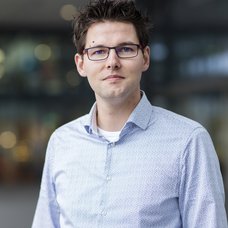
Tom Huiskamp
- Power Conversion
- Associate Professor, EIRES Research
My main goal is to research circuits that generate extremely short high-voltage pulses, to create plasmas for environmental applications - such as air purification and sustainable alternatives for pesticides in agriculture.
External Positions
External Positions
- Visiting Scholar, University of Southern California17/05/2018 – 01/09/2018
- Visiting Scholar, University of Southern California27/02/2017 – 21/04/2017
Research Profile
Tom Huiskamp is an associate professor with research group Electrical Energy Systems at the TU/e department of Electrical Engineering. His main work is on nanosecond high-voltage pulsed power technology for transient plasma generation for environmental applications such as air purification and the generation of plasma-activated water, which can replace pesticides in agriculture. His studies focus on the entire chain: from novel pulsed high-voltage circuits to the interaction between the plasma and these circuits and from the fundamental study of the plasma to the application. Other research topics include: miniature nanosecond pulsed power technology; flexible, programmable high-voltage pulse circuits and CO2 plasmas for future-fuel and switching applications.
Academic Background
Tom Huiskamp studied Electrical Engineering at Eindhoven University of Technology (TU/e, the Netherlands) where he received both his MSc (2011) and PhD (2015) degrees cum laude (with highest honors). His PhD research, concerning nanosecond pulsed power induced corona plasmas for air purification, was carried out at the research group Electrical Energy Systems of Eindhoven University of Technology. There he was a postdoctoral researcher until his appointment as assistant professor in 2016. He was a visiting scientist at the Leibniz Institute for Plasma Science and Technology (INP Greifswald, Germany, 2016) where he worked on fundamental plasma studies and a research associate at the University of Southern California (Los Angeles, USA, 2017-2018) where he worked on marine diesel emissions remediation with pulsed plasma technology.