
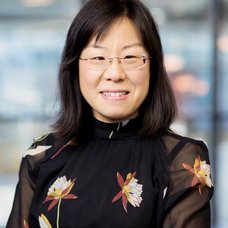
Shuxia Tao
prof.dr.
- Full Professor, Advanced Nanomaterials & Devices
- Full Professor, EIRES Research
<p>"I use machine-learning-accelerated quantum simulations to uncover the fundamental mechanisms that govern the flow of energy and information in materials."</p>
<p><span style="font-family: Calibri; font-size: medium;"> </span></p>
Research Profile
<p><span class="hover:entity-accent entity-underline inline cursor-pointer align-baseline"><span class="whitespace-normal">Shuxia Tao</span></span> is a Professor of Intelligent Materials Theory in the Advanced Nanomaterials & Devices (AND) within the Department of Applied Physics at <span class="hover:entity-accent entity-underline inline cursor-pointer align-baseline"><span class="whitespace-normal">Eindhoven University of Technology</span></span> (TU/e). Her research explores quantum phenomena in optoelectronic materials, with a particular focus on how engineered symmetry breaking gives rise to emergent electronic, optical, phononic, spin-dependent, and chiral functionality. By integrating first-principles electronic-structure theory with machine-learning approaches, she develops predictive frameworks that connect atomic-scale structure to macroscopic optoelectronic response. Her work advances the rational design of complex materials and uncovers new physical mechanisms across chiral, low-dimensional, and quantum materials platforms. Through close interaction with experiments, her research contributes to the development of materials concepts relevant to photonic, energy, and emerging quantum technologies.</p>
<p>Visit <a href="https://www.shuxiatao.com/">https://www.shuxiatao.com/</a> for details of her research.</p>
Academic Background
<p>Shuxia Tao received her master’s degree in Physical Chemistry from Nankai University, China. She obtained her PhD from TU/e in 2011, where her research focused on computational materials design for energy-related applications. From 2013 to 2016, she was a postdoctoral researcher at the NWO physics institute NIKHEF, working on optoelectronic materials for photodetectors. Since 2016, <span class="hover:entity-accent entity-underline inline cursor-pointer align-baseline"><span class="whitespace-normal">Shuxia Tao</span></span> has led her own research group, now known as Intelligent Materials Theory, in the Department of Applied Physics at TU/e. She became Assistant Professor in 2018, Associate Professor in 2023, and Full Professor in 2026.</p>
<p>Shuxia has received several prestigious grants and awards, including the CSER Tenure Track Fellowship (2016), NWO START-UP (2019), NWO VIDI (2022), and an ERC Consolidator Grant (2024). She serves as Associate Editor of <em>AI for Science</em> (Institute of Physics Publishing) and is a member of the Editorial Board of <em>Applied Physics Letters</em>. In addition, <span class="hover:entity-accent entity-underline inline cursor-pointer align-baseline"><span class="whitespace-normal">Shuxia Tao</span></span> is a member of the <span class="hover:entity-accent entity-underline inline cursor-pointer align-baseline"><span class="whitespace-normal">NWO Round Table Physics</span></span>, where she helps shape the strategic research agenda in materials physics, computational science, and artificial intelligence and machine learning (AI/ML).</p>
Metrics
All time
Scopus
citations
7197
SciVal
citations
7155
PlumX
citations
7177
UN SDGs
In 2015, UN member states agreed to 17 global Sustainable Development Goals (SDGs) to end poverty, protect the planet and ensure prosperity for all. This person’s work contributes to the following SDG(s):