
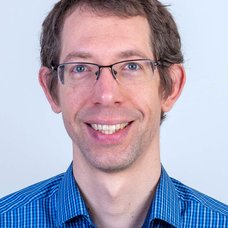
Erik Quaeghebeur
dr.ir.
- Assistant Professor, Uncertainty in Artificial Intelligence
- Assistant Professor, EAISI Foundational
<p>We are faced with uncertainty in all aspects of society, science, and technology. So we need honest conclusions, cautious decision-making, and robust systems. For that, we need to move beyond probability theory. </p>
External Positions
External Positions
- Postdoc, Delft University of Technology12/2015 – 11/2019
- Postdoc, Centrum voor Wiskunde en Informatica12/2013 – 09/2015
- Invited (guest) lecturer, Université de Liège10/2013 – 09/2015
Academic Qualifications
Academic Qualifications
- Doctor, Ghent UniversityField of study: Probability theory, statistics01/10/2002 – 23/01/2009Project: Doctor applied mathematicsAward date: 23/01/2009
- Master, Université catholique de LouvainField of study: Mathematics, other01/10/2001 – 28/06/2002Project: Postgraduate in applied mathematicsAward date: 28/06/2002
- Master, Ghent UniversityField of study: Science and technology01/10/1998 – 06/07/2001Project: Physics engineerAward date: 06/07/2001
Research Profile
<p>Erik Quaeghebeur is an Assistant Professor of Uncertainty Representation and Reasoning in the Uncertainty in Artificial Intelligence (UAI) research group of Eindhoven University of Technology (TU/e). He has two main lines of research: uncertainty modeling and surrogate modeling.</p>
<p>In the first research line, Quaeghebeur studies how uncertainty can be modeled and how these models can be used to draw honest conclusions, make cautious decisions, and design robust systems. His research involves both probabilistic models, and models that go beyond probability theory to overcome its limitations, such as imprecise probabilities and sets of acceptable gambles. He is both interested in foundational work on formal representation of uncertainty and the efficient use of such representations in modern artificial intelligence models.</p>
<p>In the second research line, Quaeghebeur explores the various ways in which modern artificial intelligence, machine learning, and optimization approaches can be used to create surrogates—efficient emulators—of complex physical systems. In this line, he has a particular interest in sustainable energy applications and specifically wind energy production systems.</p>
Academic Background
<p>Erik Quaeghebeur holds a Physics Engineering degree from Ghent University (UGent, 2001) and an Applied Mathematics postgraduate from the Université catholique de Louvain (UcL, 2002). He received his PhD for research on the use of imprecise probabilities for learning from samples and uncertainty representation, also at UGent (2009). His academic perspective was deepened and broadened by postdocs at Carnegie Mellon University (Philosophy Department), Utrecht University (Computer Science Department), the Dutch Center for Mathematics and Computer Science (Learning Theory Group), and Delft University of Technology (Wind Energy Group). He started working at Eindhoven University of Technology in 2020.</p>
<p>Quaeghebeur has co-organized multiple conferences, summer schools, and workshops and reviews for multiple top conferences and journals. He is known for his engaging summer school lectures and conference tutorials. Furthermore, he is an active member of the Society for Imprecise Probabilities: Theory and Applications (SIPTA).</p>
Metrics
All time
Scopus
citations
513
SciVal
citations
509
PlumX
citations
515
UN SDGs
In 2015, UN member states agreed to 17 global Sustainable Development Goals (SDGs) to end poverty, protect the planet and ensure prosperity for all. This person’s work contributes to the following SDG(s):