
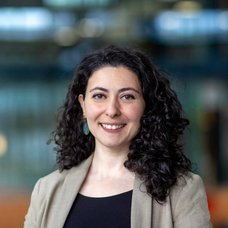
Burcu Gumuscu
- University Researcher, Biointerface Science
- University Researcher, ICMS Affiliated member
We are driven by the goals of creating knowledge unlocked from nature and then inventing solutions to address pressing questions about human health.
Academic Qualifications
Academic Qualifications
- University of California at BerkeleyField of study: Biotechnology2017 – 2018Project: Separations-encoded microparticles for single-cell analysisAward date: 01/10/2018
- Doctor, University of TwenteField of study: Nanotechnology2012 – 2016Project: Lab-on-a-Chip Devices with Patterned Hydrogels: Engineered Microarrays for Biomolecule Separation, Organ-on-Chip and DesalinationAward date: 15/09/2016
- Master, Bilkent UniversityField of study: Analytical chemistry2010 – 2012Project: BIOREMEDIATION OF 2,4,6-TRINITROTOLUENE CONTAMINATION BY NOVEL STRAINS OF AEROBIC BACTERIAAward date: 05/07/2012
Research Profile
Burcu is a tenure-track assistant professor in the Department of Biomedical Engineering at TU/e. She strives to develop, fabricate, and apply biomaterials to realize high-precision processing in high-throughput microfluidic settings. She specifically focuses on designing and developing digital microfluidic devices for studying cell-biomaterial interactions.
Academic Background
Burcu Gumuscu worked as a senior researcher in Mesoscale Chemical Systems Research Group at the University of Twente, where she performed independent research on nano-fabricated arrays for biomolecule analysis. In 2017 and 2018, she was a postdoctoral fellow in the Bioengineering Department at the University of California, Berkeley, where she developed microfluidic biosensors for single-cell analysis. She received her Ph.D. degree in Bioengineering from the BIOS Lab-on-a-chip group at the University of Twente. Her Ph.D. thesis primarily aimed at the design and development of microfluidic devices for next-generation sequencing, organ‐on-chip, and water desalination on the microscale. She is the recipient of the Pieter Langerhuizen grant given in 2019 by The Royal Holland Society of Sciences (KHMW).